> ## Documentation Index
> Fetch the complete documentation index at: https://docs.wildflow.ai/llms.txt
> Use this file to discover all available pages before exploring further.
# Roadmap
This page: [wildflow.ai/roadmap](https://wildflow.ai/roadmap)
This is a timeline for our first product [Wildflow Coral](/coral).
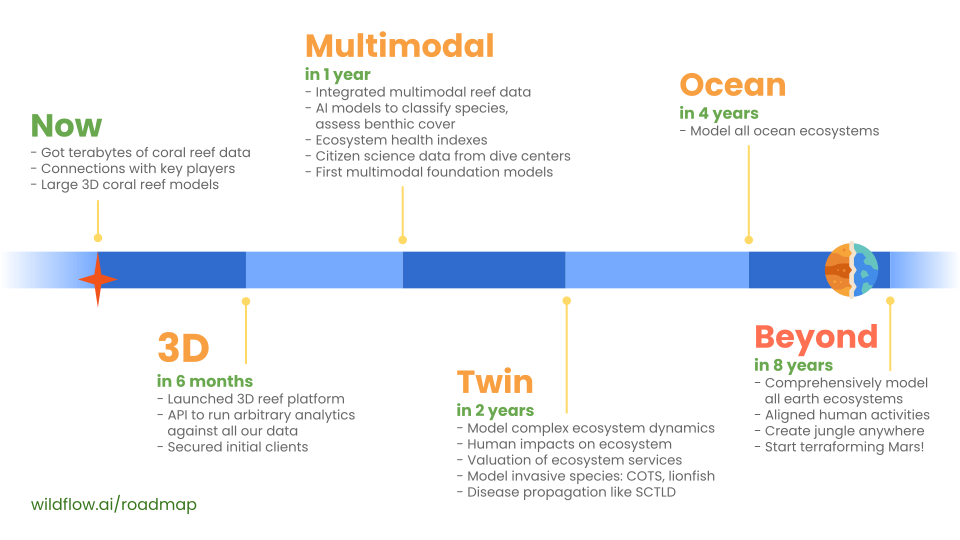
 **NOW**: we've got already a few terabytes of coral reef 3D photogrammetry data from 4 universities and the world’s largest reef restoration effort. Established connections with major research institutions, 3D data pipeline organisations, data collecting companies, restoration projects and reef analytics research groups.
Rapidly launch open 3D reef data platform, hosting existing high-resolution
photogrammetry datasets from top research labs. Simultaneously, develop
tools for visualising and labelling these massive 3D models (over 100GBs
each) in the browser. Develop an open API to run analytics pipelines against
all our data, allowing researchers from all over the world to collaborate on
these models. This establishes Wildflow as the go-to hub for reef data and
generates immediate interest. Conduct a survey (a public catalogue) to
locate existing coral reef datasets to integrate (for other modalities).
Secure an initial paying client, showcasing the platform's value in
monitoring restoration efforts.
Expand the data platform to integrate multimodal data sources like
acoustics, videos, eDNA, satellite imagery, and environmental data. Develop
AI models that understand and integrate all multimodal data inputs alongside
the existing 3D data. Classify species, assess benthic cover, and estimate
reef health using mechanistic models (e.g. for biodiversity credits). Start
training the first multimodal foundation models for biodiversity (two
modalities first). Target conservation and restoration projects as early
clients. Partner with dive centres for citizen science data collection
(starting with 3D models), further enriching the platform.
Develop comprehensive digital twins of coral reefs, modelling ecosystem
dynamics (connectivity, predator-prey, phenological events, etc), human
impacts (management of invasive species like COTS or lionfish, stony coral
tissue loss disease (SCTLD) propagation, etc.), and valuating ecosystem
services. This “digital twin” enables "what-if" scenario modelling and
guides targeted interventions. Expand to other markets beyond
conservation/restoration projects. Many people have started building their
own applications on top of Wildflow Coral. Coral reefs around the world are
starting to revive!
Expand our tech to adjacent ecosystems like oyster reefs and seagrass
meadows. Wildflow Coral’s modular architecture, along with its proven AI
capabilities and insights into critical marine habitats, further refine our
ability to model complex interactions within the ocean's interconnected web
of life.
We have AI models that comprehensively understand all ecosystems on our
planet. We built a strong “digital nervous system for our planet”. We
aligned all human activities with our understanding of nature. We found a
balance between humans and nature. We empower each other!
We have superhuman abilities to create a jungle out of any desert (a truly
functioning ecosystem). We can even terraform Mars now!
**NOW**: we've got already a few terabytes of coral reef 3D photogrammetry data from 4 universities and the world’s largest reef restoration effort. Established connections with major research institutions, 3D data pipeline organisations, data collecting companies, restoration projects and reef analytics research groups.
Rapidly launch open 3D reef data platform, hosting existing high-resolution
photogrammetry datasets from top research labs. Simultaneously, develop
tools for visualising and labelling these massive 3D models (over 100GBs
each) in the browser. Develop an open API to run analytics pipelines against
all our data, allowing researchers from all over the world to collaborate on
these models. This establishes Wildflow as the go-to hub for reef data and
generates immediate interest. Conduct a survey (a public catalogue) to
locate existing coral reef datasets to integrate (for other modalities).
Secure an initial paying client, showcasing the platform's value in
monitoring restoration efforts.
Expand the data platform to integrate multimodal data sources like
acoustics, videos, eDNA, satellite imagery, and environmental data. Develop
AI models that understand and integrate all multimodal data inputs alongside
the existing 3D data. Classify species, assess benthic cover, and estimate
reef health using mechanistic models (e.g. for biodiversity credits). Start
training the first multimodal foundation models for biodiversity (two
modalities first). Target conservation and restoration projects as early
clients. Partner with dive centres for citizen science data collection
(starting with 3D models), further enriching the platform.
Develop comprehensive digital twins of coral reefs, modelling ecosystem
dynamics (connectivity, predator-prey, phenological events, etc), human
impacts (management of invasive species like COTS or lionfish, stony coral
tissue loss disease (SCTLD) propagation, etc.), and valuating ecosystem
services. This “digital twin” enables "what-if" scenario modelling and
guides targeted interventions. Expand to other markets beyond
conservation/restoration projects. Many people have started building their
own applications on top of Wildflow Coral. Coral reefs around the world are
starting to revive!
Expand our tech to adjacent ecosystems like oyster reefs and seagrass
meadows. Wildflow Coral’s modular architecture, along with its proven AI
capabilities and insights into critical marine habitats, further refine our
ability to model complex interactions within the ocean's interconnected web
of life.
We have AI models that comprehensively understand all ecosystems on our
planet. We built a strong “digital nervous system for our planet”. We
aligned all human activities with our understanding of nature. We found a
balance between humans and nature. We empower each other!
We have superhuman abilities to create a jungle out of any desert (a truly
functioning ecosystem). We can even terraform Mars now!