> ## Documentation Index
> Fetch the complete documentation index at: https://docs.wildflow.ai/llms.txt
> Use this file to discover all available pages before exploring further.
# Wildflow

 # Problem
**Natural ecosystem services** provide benefits of [**\$125-140T**](https://www.sciencedirect.com/science/article/abs/pii/S0959378014000685) **per year**, surpassing the entire [global GDP](https://www.statista.com/statistics/268750/global-gross-domestic-product-gdp). Sadly, we already [**lost 69%**](https://www.livingplanetindex.org/) **of living things** on the planet over the **past 50 years**. **To survive** as a species, we must **protect our ecosystems**.
# Problem
**Natural ecosystem services** provide benefits of [**\$125-140T**](https://www.sciencedirect.com/science/article/abs/pii/S0959378014000685) **per year**, surpassing the entire [global GDP](https://www.statista.com/statistics/268750/global-gross-domestic-product-gdp). Sadly, we already [**lost 69%**](https://www.livingplanetindex.org/) **of living things** on the planet over the **past 50 years**. **To survive** as a species, we must **protect our ecosystems**.
Natural ecosystems are incredibly complex
Did you know [wolves make rivers](https://rewilding.academy/rewilding/how-wolves-change-rivers/)? We don’t really understand how ecosystems work. Especially the ocean – it’s like a black box – **we still know less about the ocean than about outer space**. We need to protect our ocean, and we don’t have much time for it. We need to deploy more solutions faster. **A lot of amazing people** genuinely **wan**t and are trying **to help the ocean**! Unfortunately, often, **poor understanding leads to poor decisions that eventually harm nature**. Luckily, **we now have a ton of data to understand oceans** better. In 2018 alone, we had more ocean data than in the entire 20th century ([Nature](https://www.nature.com/articles/d41586-020-01668-z)). It’s growing rapidly and will continue growing with the development of robotics, new sensing solutions, and data collection companies. So the big challenge is
**how do we process** this insane **“tsunami” of data**, comprehensively
**understand how natural ecosystems function**, and **empower humans** to make
**better decisions on protecting/restoring our ecosystems**?{" "}
This time, we need to act fast and **have no room for error**.
# Solution
The good news is that **AI can help.** It’s great at analysing massive amounts of data and helping make quality decisions. Its **capabilities are growing**. People are working on foundation models for robots, geospatial data, chemistry, physics, and more. These are large-scale AI models trained on massive amounts of data and adapted to perform various tasks. We need **foundation models for biodiversity** to **model** natural ecosystems, especially **the ocean**.
# Wildflow
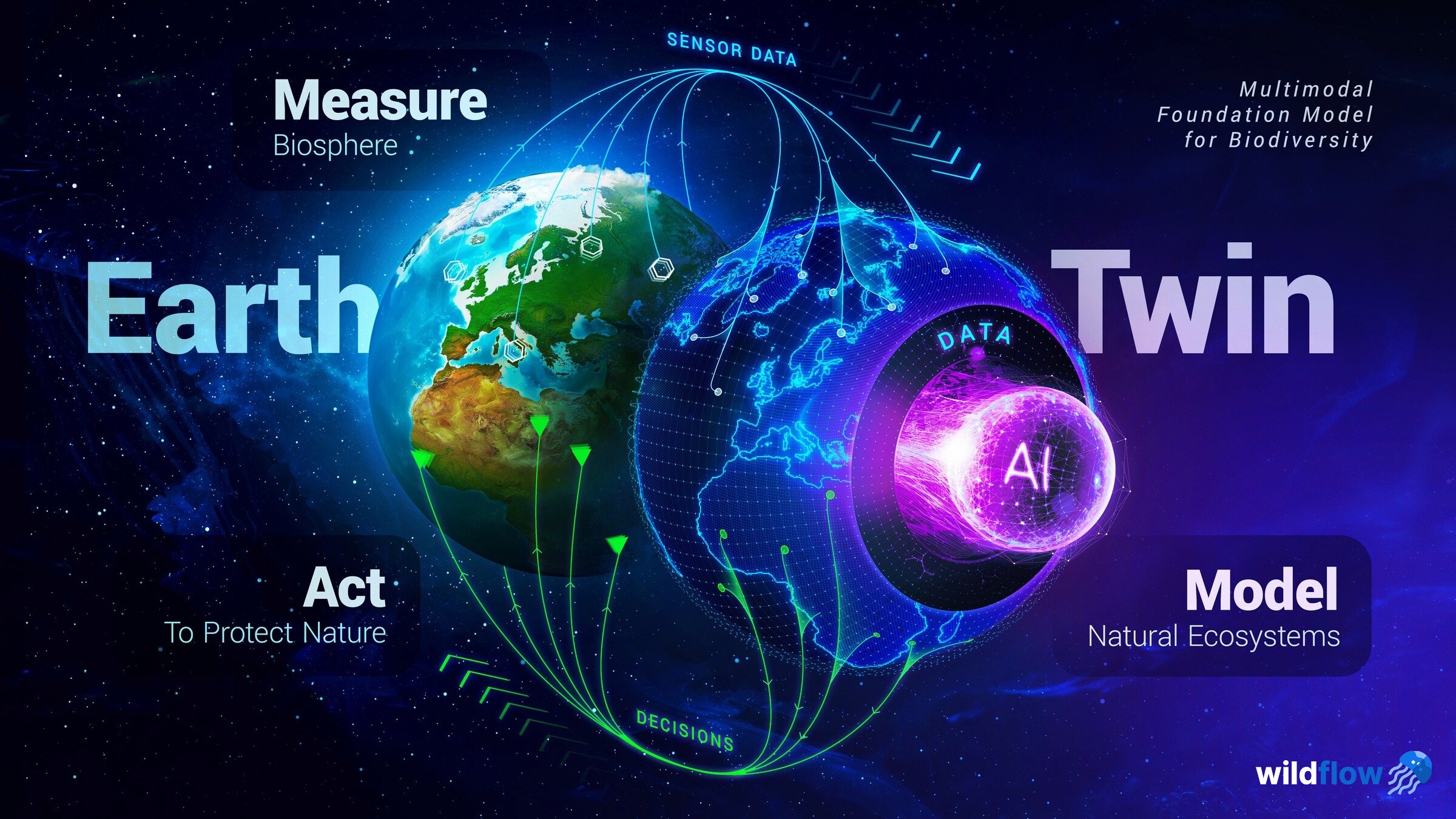
Wildflow was founded to **comprehensively understand nature** and **empower humans** to make **better** **decisions about protecting our ecosystems**. Wildflow (**wild**life + data**flow**) is a **planetary digital nervous system** that connects **all** **sensors** measuring the biosphere, such as eDNA, underwater cameras, bioacoustic microphones, remote sensing, etc., to **real-world actions** like restoring coral reefs, creating marine protected areas, preventing algal blooms, managing invasive species, etc. We’re building **multimodal foundation models for biodiversity**, trained on the insane amounts of raw sensor data from the ground up, and comprehensively understanding how ecosystems function. All **intricate ecosystem dynamics**, such as population dynamics, predator-prey dynamics, phenological events (like coral spawning), etc. How agricultural runoff, overfishing, and other **human activities impact ecosystems**. **How ecosystems affect humans** through ecosystem services, like oxygen production, water purification, coastal protection, tourism and more. It’s the **ultimate digital twin of nature**, allowing people to simulate different **“what-if'' scenarios** and see how our decisions impact ecosystems. It deeply understands nature and guides human activities.